March 12, 2026
Asian Americans in the Media, What’s Changed?
By John Myers
By Jeffrey Wang
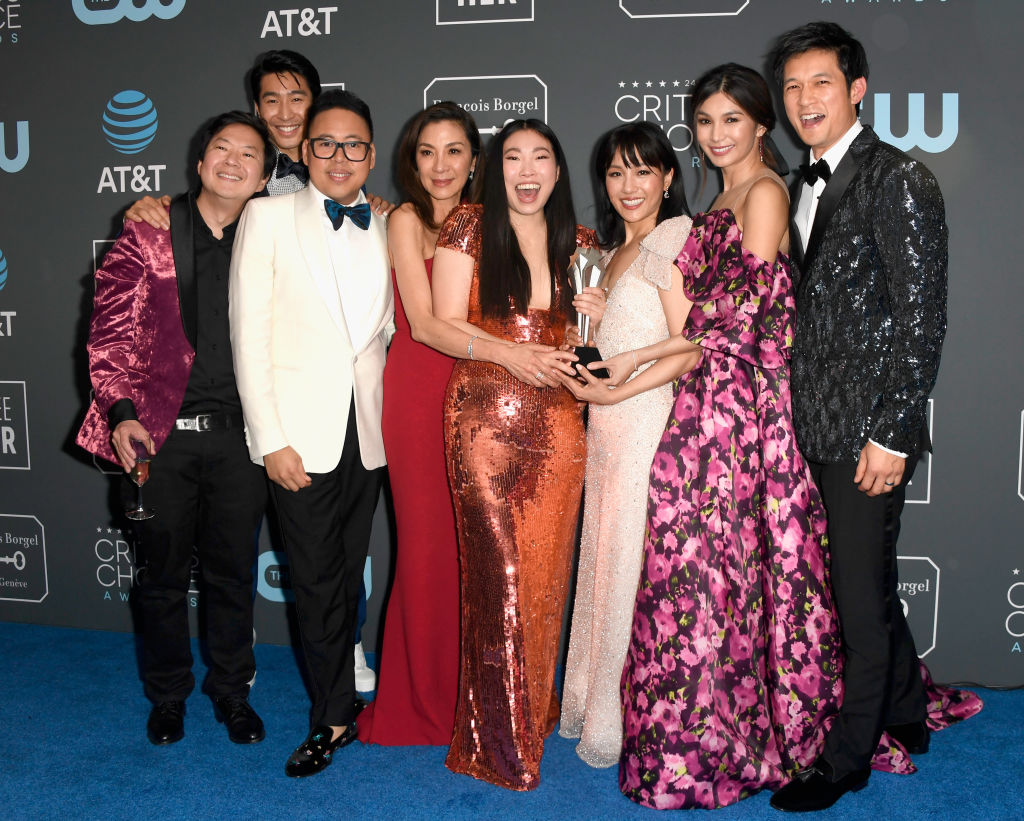
SANTA MONICA, CA – JANUARY 13: (L-R) Ken Jeong, Chris Pang, Nico Santos, Michelle Yeoh, Awkwafina, Constance Wu, Gemma Chan, and Harry Shum Jr., winners of Best Comedy Movie for ‘Crazy Rich Asians,’ pose in the press room during the 24th annual Critics’ Choice Awards at Barker Hangar on January 13, 2019 in Santa Monica, California. (Photo by Frazer Harrison/Getty Images)
Sitting on my bed, finishing the last episode of the newly released Heated Rivalry, I was impressed by how well it captured a unique Asian American perspective. The story, which explores sexuality, had me feeling sadness, anger, joy, and gave me the ability to relate to the character on a much deeper level than ever before.
Growing up as an Asian American, I’ve always been eager to see films and TV shows with characters that I could relate to. Over the years, I’ve watched many centered around Asian experiences, and though I enjoyed them, they didn’t always feel relatable. The dynamics of the relationships often felt unrealistic, more comedy than documentary.
Shows like Never Have I Ever, Fresh Off the Boat, and Crazy Rich Asians felt too lighthearted. Like most popular media depicting Asian Americans, they capture some aspects of the culture while whitewashing most of the difficulties. Suited for a mainstream white American audience, they heavily employ traditional stereotypes like the overbearing mother always asking about grades, the tired, absent father, and the competitive sibling rivalry. The conflicts in these shows often felt too shallow and unnuanced, and themes of guilt and identity were superficial and repetitive. They bolstered the now clichéd “model minority” stereotype, painting an image of us that we didn’t ask for .
This portrayal isn’t exactly new either. Beginning in the 1960s, when Asian Americans started to appear in American films, they were almost always depicted with model minority characteristics, like being studious, disciplined, apolitical, and assimilated. These narratives were deeply anchored in American media, and largely didn’t change until the 1990s, when shows like The Joy Luck Club began to portray more varied experiences, and even focused on the relationships among the characters depicted. More recently, movies and shows like Minari, Pachinko, and Didi show aspects of the Asian American experience often hidden from Western audiences, hinting at change.
However, in a 2022 survey by Nielson, in which 41,000 Asian Americans across the country from various ethnicities were digitally surveyed, more than half the respondents felt that their portrayals were inaccurate, and two-thirds felt that representation wasn’t enough. More specifically, these respondents felt especially underrepresented in genres like crime, horror and romance, which ties into another part of the study that states, “In 2020, the dominant themes in the stories when Asians were present were cerebral, thoughtful and good, which reinforced the model minority myth.” In other words, not much has actually changed.
And there’s another issue: funding for small independent films, including those depicting Asian experiences, are drastically diminishing. These low-cost films, made by emerging, less established artists, are a lifeline for accurate representation, bringing to light what Hollywood won’t—the aspects of our experience that are raw, unfiltered, and ugly. Recent cuts to the funding of nonprofits like the Corporation for Public Broadcasting (CPB) by the federal government pose a threat to small-time filmmakers, who are unable to privately fund these projects, thus widening the gap between Hollywood and reality.
Though we’ve made substantial progress as a society in bringing Asian Americans to the screen, their portrayal is just as important. Seeing my parents flattered by how Americans view us as “studious” and “successful,” I realize how much this narrative is used against us. A National Study of College Experience from 2009 showed that Asians needed 140 SAT points higher than whites for admission to universities. Essentially, the “model minority” myth works to hold Asian Americans to a higher standard than white applicants, despite them being statistically higher to face discrimination in education settings, perpetuating beliefs about Asians not only to other audiences, but also to Asians themselves.
Beyond just the desire for more multifaceted representation in the media we consume, these depictions can impact us in the real world. It’s not a coincidence that Asian Americans have the least representation in genres like horror and crime. If we’re always being portrayed as obedient, apathetic people with grade-obsessed parents, we won’t ever be truly represented, no matter how many Asian actors and actresses get leading roles. I truly hope that the popularity of shows like Heated Rivalry show Hollywood that diverse narratives can and will succeed.