March 12, 2026
Is College Really an Attainable Goal for Everyone?
By John Myers
By Sanaii Coke
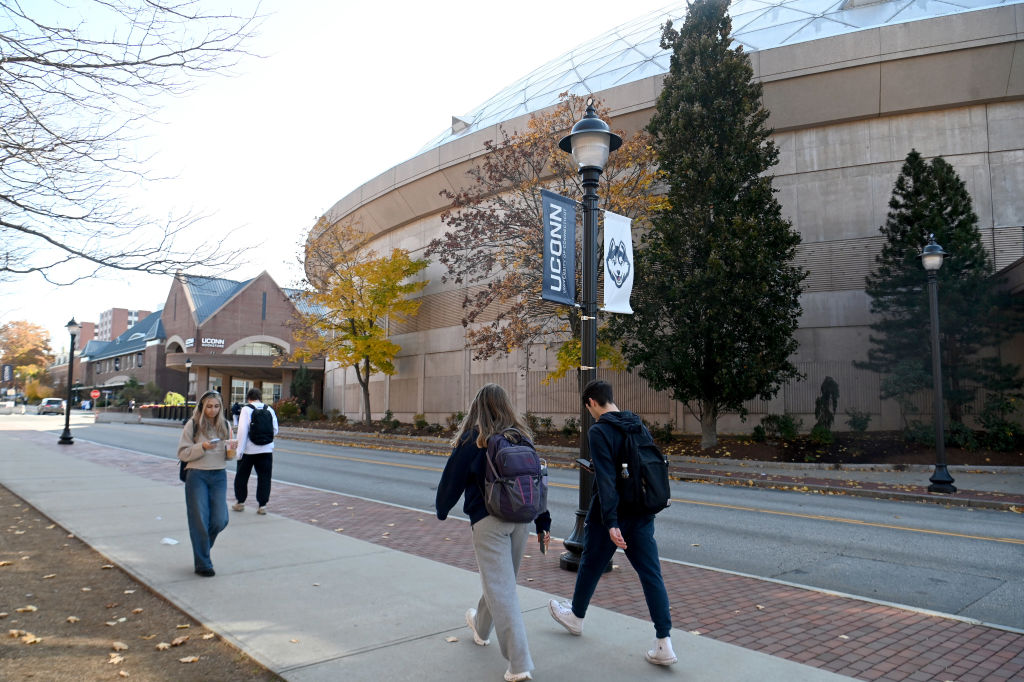
STORRS, NY – OCTOBER 28: Students walk about the Campus near Gampel Pavilion on Monday, October 28, 2024 at UConn in Storrs. (Jim Michaud/Connecticut Post via Getty Images)
As soon as students enter high school, we’re reminded about college. We’re expected to build our GPA in order to get into the college of our dreams and get the degrees needed for the job of our choice. Sounds pretty simple, right? Typically the idea of a college or university experience is promoted in schools while community colleges are frowned upon and seen as less than. However, as a high school student, when researching colleges, the biggest obstacle I face is the cost.
According to Education Data Initiative, “The average in-state student attending a public 4-year institution and living on campus spends $27,146 for one academic year” while “the average private, nonprofit university student spends $58,628 per academic year living on campus, $38,421 of it on tuition and fees.” The average American makes nothing close to that amount. According to “Average US salary by State” by Jacquline DeMarco, “The national average salary is $63,795.” In-state tuition is usually much less expensive than private school tuition. Most Americans still have multiple expenses that we have to worry about every day, which eats into our yearly salaries.
To finance going to college, students are offered the option of student loans, scholarships, grants and financial aid. However, financial literacy isn’t often taught in grade school, or even high school, which is ironic because those are the years that students need to know about finance the most. With student loans, students are encouraged to take on tens of thousands in debt. Without the tools and the education to handle money, those students usually stay in debt for decades. According to the website BestColleges.com, “In 2023, among people between the ages of 18 and 29: 60% of graduate degree-holders went into debt for our education. 57% of bachelor’s degree-holders incurred student debt and 39% of associate degree-holders incurred student debt.” With most of the people who have gone to college still having debt from college in their later years, university seems undesirable in the long run. But, apparently, a college degree is what many Americans need to make a comfortable living.
If students decide not to incur debt with student loans, scholarships and grants are highly competitive. Students are sold this idea that if we sign up for as many scholarships and grants as we can, we’ll be able to go to college for free. While that’s true for some, it’s not true for most. There is also the option of state schools, which in New York are referred to as SUNY schools (State University of New York). Now if you live in-state, the tuition will be more affordable as being local lowers tuition, which may be the best option along with community college. There are a lot of students though who’d like to gain new experiences from different types of people. Being local takes away from that opportunity in college and narrows the scope of networking opportunities.
Community college is often the most realistic option. Community college is much more affordable and flexible with the average cost being $3,800–$4,000 annually. High schools typically push four-year colleges as the goal, which tends to stigmatize lower-income students for whom community or junior colleges might be a better option. Pressuring them to choose a four-year college or university might jeopardize them financially in the future. The way that students are seen in society matters. For instance, when interviewing for a job, is it better to note that you went to a university or a community college? College allows for networking and opportunities to build with other people, the social aspect is just as important as anything else. That it’s much easier financially to attend a community college but it’s frowned upon by most schools reveals where the focus is when it comes to education. It’s not what’s most affordable and will also educate you but what will get you to spend the most money so you’re stuck in a cycle of debt with the illusion of higher and “better” education.
Countries such as Germany, Norway, the Czech Republic and Iceland provide free college education for its citizens. Although it raises taxes, it takes off a huge financial burden for its students. There are also countries with significantly lower tuition than the U.S. such as Australia, Canada and the UK. These countries function completely fine without extremely expensive college tuition fees so why can’t we?
The idea of prestige equating to success is what holds a lot of students back when it comes to college applications. Worrying about the money and prestige at the same time creates even more stress for students at this already stressful time. What would success look like if affordability mattered and was valued over anything else?