December 30, 2025
Unplugged: The New Age of Digital-Free Learning
By John Myers
By Emily Batista
Starting in the 2025–26 school year, New York state law prohibited in-school usage of personal internet-enabled devices. In high schools like Celia Cruz Bronx High School of Music, students previously had unsanctioned use of their own devices—during free periods or discreetly in class. With the end of thatl approach, the law is impacting learning opportunities and forcing creative compromises among students. This sudden shift in policy is causing controversy.
According to the New York City Department of Education, Chancellor’s Regulation A-413 solidified a restrictive use of personal devices in schools—including cell phones, laptops, tablets and any other portable entertainment devices. The regulation is intended to create a more conducive learning environment for students, aiming to free them from distractions, improve focus and deepen social interactions overall. New York Governor Kathy Hochul, who initiated the ban, had purposely rolled out this new model in schools to help them become “distraction free.”
At the heart of the debate among supporters and critics is whether the ban actually reduces digital distractions. Students in schools across New York are all shifting from academic habits shaped by the use of personal devices. The new law is enforcing rigid and strict rules and disrupting routines, resulting in adjustments to classroom procedures across schools.
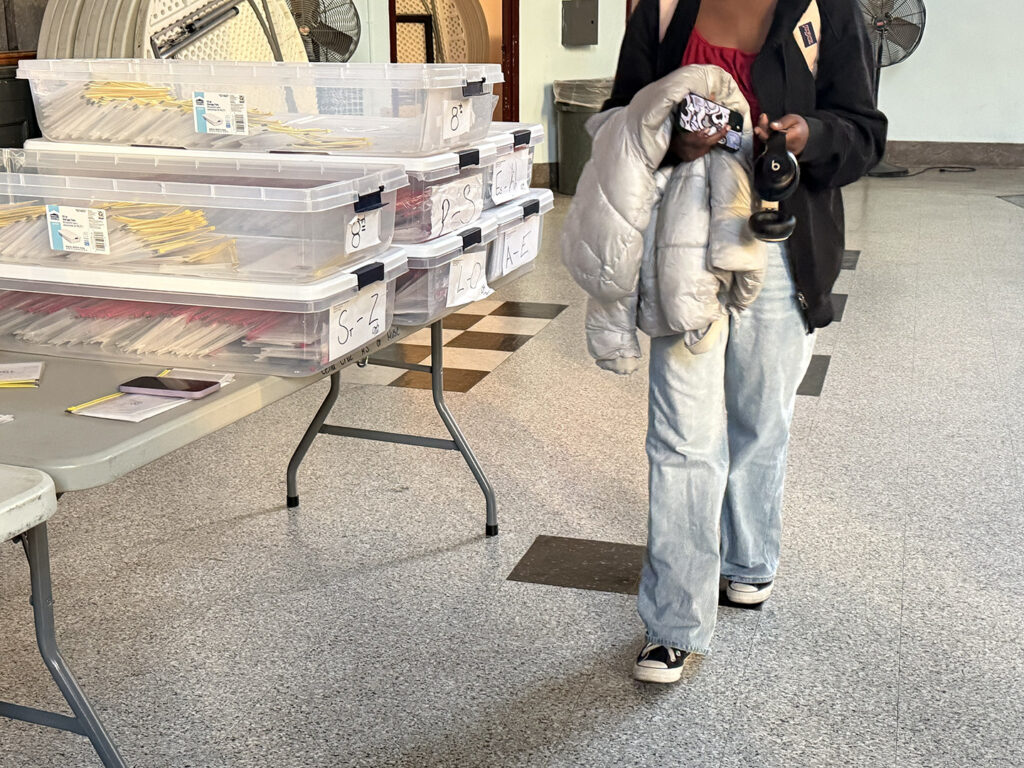
At Celia Cruz Bronx High School of Music, there’s a structured system for collecting and managing students’ devices each morning. Students line up to hand in their phones, which are placed in labeled ziploc bags, and sorted alphabetically. Faculty manage the bins, and students provide their name or number attached to their device to ensure proper sorting.
David Abreu, a paraprofessional who oversees this process, shares his perspective on this change, “I think it’s very positive. I think it keeps the kids more engaged in their school work and less distracted on other outside activities.”
However, disagreements still remain.
Junior Mia Reyes, argues that, “Overall I’m against it, it causes a lot of unnecessary problems. The focus on phone discipline needs to be redirected.” She explains that, “There are more unmotivated students, especially as everyone relies on their devices, especially after COVID.” This rising level of demotivation among students raises difficulties in planning school events like shows and pep rallies. Misconceptions rise and communication plummets as students continuously struggle to coordinate themselves, and it creates a tension that exceeds beyond the classroom.
Lesly Victoriano, also a junior, sees both sides of the argument. “It helps students become more integrated—socially and academically.” Yet, “It could be bad because of emergencies, I guess.”
Victoriano stands between both sides of the controversy as she conceives the pros and cons of the ban. She notes, however, that the policy is a step toward having a more academically driven environment.
Allison Christian, a chemistry teacher at Celia Cruz, said the ban provides security and eases stress, allowing students to be themselves without worry. “Everything has been running much smoother, classes are fuller, students are participating in class, and overall students have been more social.” She added that it’s way more beneficial for students to be engaged in the academic materials provided to them during class.
Yet, this experience at Celia Cruz High School of Music, and New York State schools are not unique. Across the United States there have been implementations of restrictive use of technology in school. In past years, several states including Florida, and Texas, have enacted their own bans on personal technology in learning environments.
Florida’s statewide ban— legislated under CS/HB 379 was implemented in 2023. It was mandated within K-12 Public schools to keep devices out of reach during instructional time, requiring students to lock away their devices or store them in specific designated areas.
Texas had followed with the House bill 1481— passed in 2025, requiring a full prohibition of student usage of personal communication devices during school hours.
Across these states, the ordeal remains the same–to reduce distractions and an aim to rebuild academic solidarity during an outside environment that is encapsulated in technology.
For many students, devices can fit the role of many things, such as a planner, a research tool, and communication outreach. Without them, routines that were once automatic and simple require new structure, time, and patience. Students are now turning back to physical planners to track assignments, relying on devices the school provides, and verbal instruction from teachers and peers.
An increasingly hard transition, as Juan Alvarez stated, “The phone law isn’t necessary, as all the problems it’s supposed to fix aren’t due to the devices themselves; it’s the people behind them. The phone law causes miscommunications and makes it much harder to time plan and to do other ordinary functions.” Academically, the shift has placed new challenges on him. “Ever since the bill has been put in effect, maintaining my grades has become significantly harder… I would do all my work during lunch on my phone and use my devices to study, but now it’s much harder due to the lack of resources at hand.”
As schools adjust, the overcompensation in a strict, structured environment with device-free learning is creating new challenges, leaving students overwhelmed, confused, and struggling to rebuild their daily life routines. The uncertainty of this law carries through in a world that increasingly depends on technology.