December 30, 2025
Where Seeds and Community Grow
By John Myers
By Alisa Uchaykina
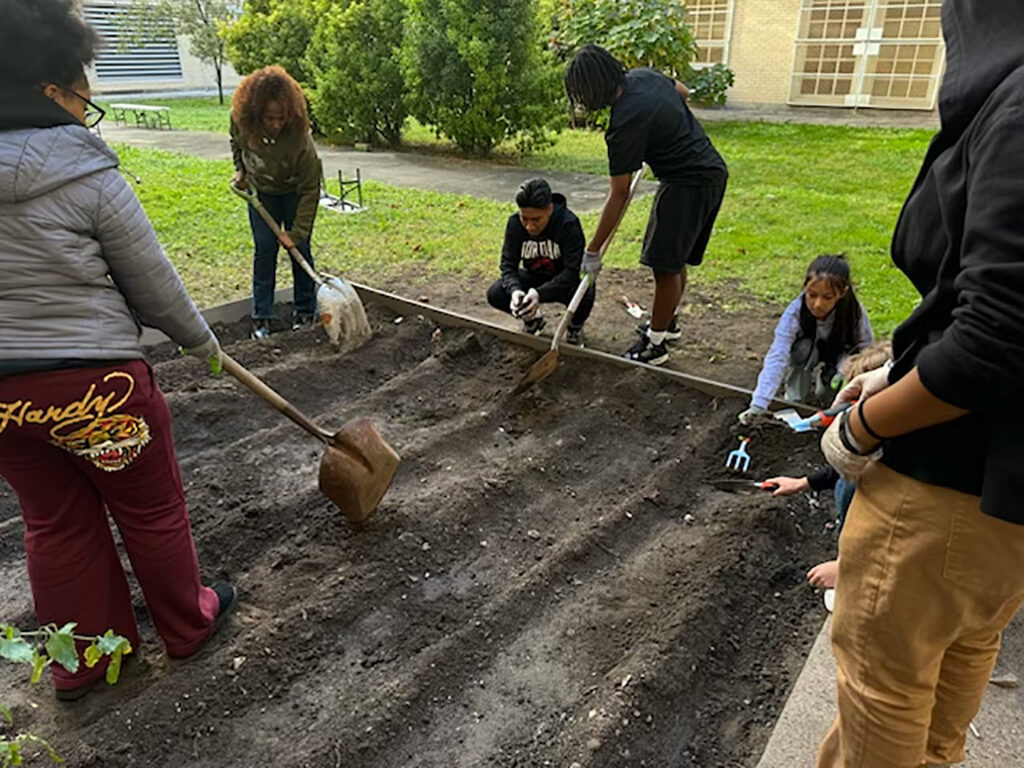
After school, you can hear the sound of small shovels, students’ laughter, the rustling, the wind — that’s what the Gardening Club sounds like. At Kingsborough Early College Secondary School, students recently started the club under the supervision of biology teacher Tasha Grant, with help from main office staff member, Jose Reyes.
The club’s foundation was rooted in students’ interest in spending time after school in a meaningful and sociable way. They carefully observe how each plant grows, analyze what happens, and try to figure out how to make it better. All summer, teachers studied sunlight and other factors to find the best place for the garden. In turn, the school provided the club with rakes, shovels, gloves, seeds, soil, and the garden space itself. Beyond simple gardening, one of the club’s goals is to address a real problem faced by many young people today: lack of access to fresh, nutritious food. By learning to grow their own food, students gain a practical understanding of healthy eating principles.
One of the club’s founders, junior Kyleigh Ribot said, “We wanted to create something that has both aspects of education and interaction with others. The club gives students a sense of responsibility as you are taking time out of your day to grow things, but it also gives you time to reflect on nature and the damage that we do to it — that’s something we also discuss in the club. Overall, it gives you a well-rounded perspective on life.”
Nowadays, many students aren’t getting nearly enough nutrients — especially in large cities like New York. In fact, according to the New York City Department of Health, only 35% of children ages 6–12 eat the recommended daily amount of fruit, and just 6% meet the daily vegetable recommendation. Research from the Center for Disease Control also shows that most teens get over 60% of their daily calories from ultra-processed foods, which are higher in sugar, salt, and unhealthy fats, but low in essential nutrients. This also applies to adults ages 19–39, who on average consumed 54.4% of their calories from ultra-processed foods.
This combination of low produce intake and high junk-food consumption makes nutrient gaps common. Low consumption of fruits and vegetables means kids often miss out on vital vitamins, minerals, and fiber needed for healthy development. That’s why it’s so important for students to learn how to eat healthy and understand how to grow their own food — this is one of the club’s main goals.
Grant, the club’s advisor, explains, “Even though New York City has a few urban farms, most students have never actually seen how food goes from farm to table. When I ask them, ‘Where does your food come from?’ Most of them don’t know. That’s why the main mission of our club is to help students understand how food grows, where it comes from, and how they can take part in growing it themselves.
“With winter approaching, we know that some plants may freeze, so we want to make sure we’re prepared and ready for spring. Right now, we’re working on getting proper coverings for the plants. In addition to expanding the garden, we’re also planning to build raised beds so that we can grow more produce and donate it to those in need.”
Kayla Termilus, also a junior and one of the club founders, explained their current plan. “We specifically chose winter crops that will be ready to harvest by the end of the season. And when it gets too cold or starts snowing, we’ll move indoors and work on growing herbs in Mrs. Grant’s classroom. So we actually have work both outside and inside! We’re also applying for a DOE grant to get a greenhouse. If that doesn’t work out, we’ll try for a smaller grant that can help us grow more plants indoors.”
KECSS offers a wide range of clubs, and new ones continue to form and grow. One of the school’s unique features is that it shares a building with four other schools, creating opportunities for collaboration. The gardening club currently has 30 young gardeners. As the garden expands, the club hopes to include students from the other schools as well — bringing more young people together through a shared project.
Freshman Nathanael Louis Jacques, another member of the club, said, “I joined the club because I’d been watching videos about planting, and the whole growth process really fascinated me. I wanted to try it myself. Since joining, I’ve learned how plants grow and how much they can change in just a few days. I really enjoy being in the club, and I’d definitely recommend it — plants have so much more to them than we usually notice.”
Despite being newly founded, the club has already grown beets, onions, and cucumbers. The students continue to work hard, and with their dedication, the garden is sure to flourish in the coming seasons.