October 28, 2026
The Mind-Body Connection in Music Education
By Quinn Dwyer
By Emily Batista
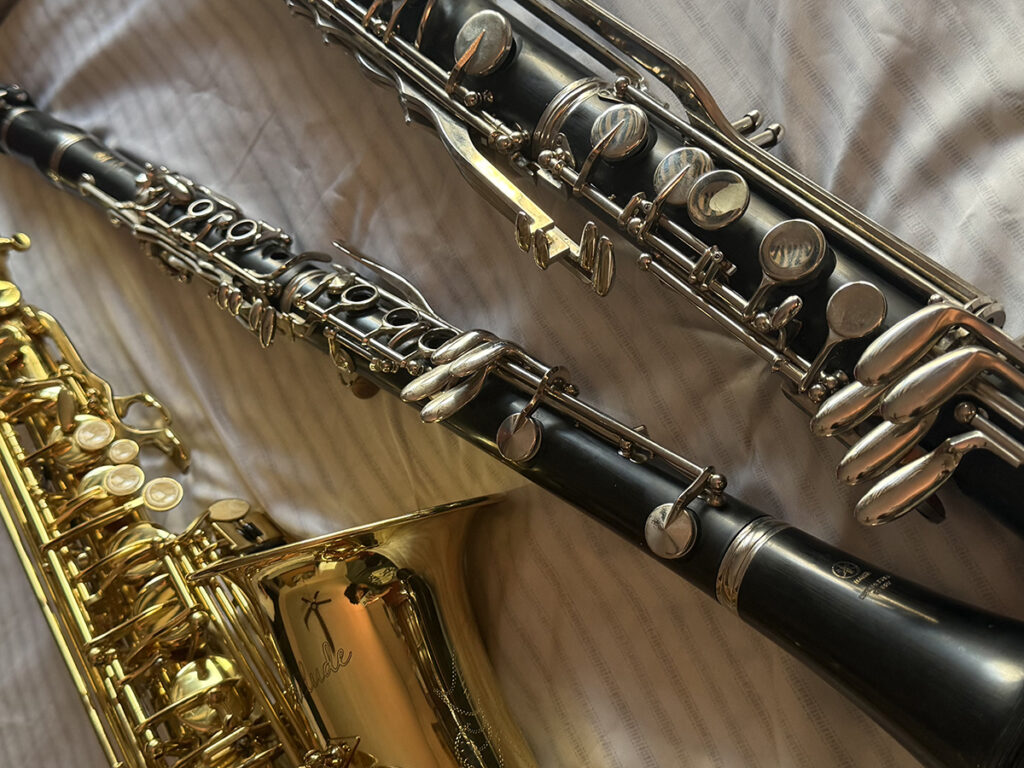
“Why didn’t you tell me you played saxophone?” my middle school band director asked.
I paused for a moment.
For many people, music is an expression, it’s a language. To me, music may have just been my first language. So, when my band director asked me that question, I paused. Music was something so familiar to me that I never even questioned its centrality in my life.
According to the NYC Public Schools Arts Office, arts education is considered essential to student learning and development, New York City public schools are expected to uphold and provide students with opportunities to meet state arts requirements.
Celia Cruz Bronx High School of Music is a school built around music. There are many different forms of music, and those aspects of identity and culture are all important. Music education helps students develop confidence, creativity, discipline, and a sense of community.
In my school, you can hear faint echoes of music throughout the hallways. Someone is practicing their flute, a trumpet player is running their scales over and over, a singer is repeating a chorus for the thousandth time. There is always music somewhere.
Jazz, however, holds a special place for many people at my school. Jazz is rooted in collaboration, and most importantly, in storytelling. It’s a way to hold a conversation. For me and many around me, it is a unique and emotional experience. When I step inside my recital hall, my instrument becomes attached to me, and I face parts of myself that I cannot express with words.
“Music is fun, it pushes me out of my comfort zone. It’s easy to pour all of my energy into it,” says Angelique Clark, 17, a student at Celia Cruz.
Unlike many other forms of music, jazz encourages improvisation. Musicians are expected to create something unique in the moment, making every performance different. This freedom allows young musicians like my peers and me to develop confidence in our abilities and convey the message we want to express.
But sometimes that ambiguity can be scary, especially when you don’t know exactly what will happen when you play or listen. Honestly, I’m almost always anxious about making a mistake, whether I’m in rehearsal or on stage. Yet, it may just be exactly what you need. According to researchers Sirke Seppänen and Tapio Toivanen, when you tolerate the fear that uncertainty brings, you eventually develop the ability to remain present and find yourself taking in your surroundings and bodily sensations, it becomes a multisensory experience.
Joanna Tang, 16, a student at Celia Cruz, explains that while in the moment of making music, improvisation is one of the key ways to grasp yourself, “When playing jazz, I feel confident because I’m allowed to express my feelings through improvising.” Tifany Nicasio, 16, who also attends Celia Cruz, explains that “music has been one of the most grounding activities I have ever done—it has brought my spirits up countless times.” This freedom in music is a powerful message that every student should be able to express.
Mary-Kate Mutze, a band director at New School for Leadership and the Arts in the Bronx, New York, believes music education teaches students skills that extend far beyond the classroom. Having attended a music high school and pursued higher education in college, she understands the impact music has. Through her work as a band conductor, she’s a key part of the community that helps students grow into themselves and feel they belong during the most fundamental years of their lives. “There is something very special about being a musician, especially during the formative years of being a student and being part of an ensemble,” Mutze said.
I think I understand that feeling when I play, my body is reacting in waves, but strangely the more I play the more I feel settled. Neuroscientist Valorie Salimpoor and her colleagues evaluated that shift, their findings include that music can “arouse feelings of euphoria and craving,” linking the experience of musical pleasure to the brain’s reward system.
Through rehearsals and performances, this induced euphoria can also help provide students with long-term developmental skills such as responsibility, communication, and discipline. However, most importantly, a defining aspect of music is belonging. In a world where many search for a sense of community or a safe space, music is right there in your ear. Performer or listener, it can be linked to you too. Music can make that special connection.
That special connection is what makes me find belonging in music—something that helps me reach my emotional peak. To me, music is a cycle, to sit with uncertainty until you are met with comfort. The palpitations of the heart before my hands meet with my instrument, the way my fingers slowly relax as I continue to pace myself through my music, and the way I can express myself in ways I may not be able to with words. I’ve learned to listen, respond, and most importantly, trust. To my teachers, from the young nine-year-old me to the taller, more mature 17-year-old me, music is what I thank for the times it understood me when I couldn’t understand myself.
“Every person deserves to experience music education in their lifetime, and our world needs the long-term societal benefits of this character development now more than ever,” Mutze adds.
I believe everyone should have the opportunity to have music in their lives, it’s never too late to start. Your beginnings have yet to begin.