October 28, 2026
The Other Side of Beauty Standards
By John Myers
By Veralyn Vislocky
For generations, conversations about unrealistic beauty standards have largely centered around women. From advertisements and magazines to movies and television, women have faced constant pressure to look a certain way—to appear thinner, younger, prettier and more “lady like.”
Growing up, I understood that it was mostly a thing for women. I even felt some of that pressure myself as a young girl, especially when I started to do ballet. My mom would do my makeup for recitals because it was required. At first, it was just something fun I would put on for my performances. But eventually I started wanting to wear it outside of ballet, too. This went on for a while, and I started associating makeup with being more girly and feeling prettier.
As I’ve gotten older, I learned not to rely on makeup so much. I still wear it pretty regularly, but I can confidently say that it’s purely for fun and my own enjoyment.
So when my brother recently came into my room asking to borrow my eyeliner, I said “sure” without questioning it. I handed him a brown and a black one, turning back around to do something on my computer. But then he asked, “What would make my cheeks look more hollow, the black or brown?” and suddenly I was confused. I had thought he just wanted to see what eyeliner would look like on him, like on his eyes.
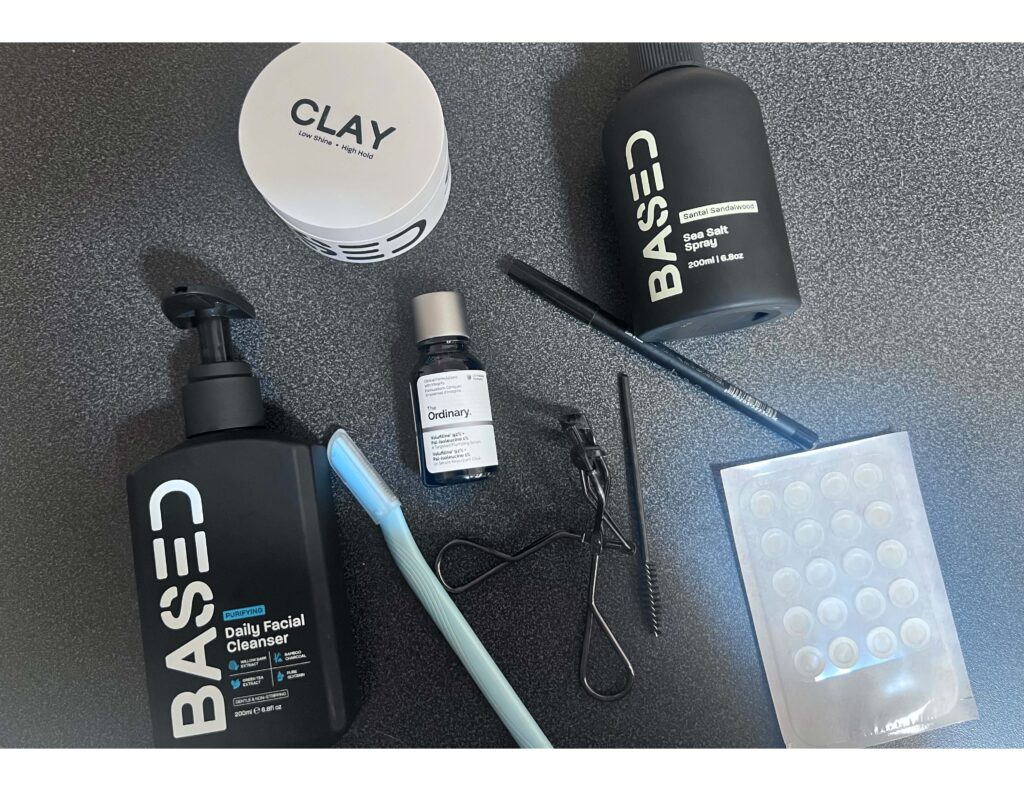
He explained that he had seen guys online using a “man pen” to make their cheeks look more hollow by drawing under their cheekbones. When he showed me what it was, it was basically just like the eyeliner he had in his hands, except the price was hiked up way more. It was being advertised as not being makeup, just a pen. I’d never imagine people would pay so much more for something just so they wouldn’t have to admit to wearing makeup.
I also didn’t imagine that my brother would be so concerned about his cheekbones. He only just finished his first year in high school, so he’s still very young. But the more I thought about it, the more it reminded me of some of my guy friends. The way that they seem to be stressing about their looks, asking for advice. I just figured it was a normal teenage thing because everyone worries about that stuff, right? But the more I thought about them and my brother, the more it seemed they were all worried about specific things relating to their looks.
My friend Owen Popov was one of the first people I thought of who stress about their looks and asks for advice. He’s 17, a few years older than my brother, and most of the people who came to mind were teenagers and young men. When I asked him where all of that stems from, he said, “Have you seen that looksmaxxing stuff on your For You page? Yeah, that stuff always gets me.” Looksmaxxing is when you intentionally try to maximize your attractiveness. The stuff people do to achieve this can be extreme, including undergoing cosmetic procedures, intense dieting, or injecting themselves with different substances or peptides. Most of the time the average consumer doesn’t take it that far, though. Looksmaxxing edits feature people that have the ideal look and have “maxed out” their attractiveness basically, promoting others to do similar things.
“I think it just started off with liking a few edits of attractive people,” Owen added. “And then the videos started pointing out different features on these peoples’ faces that made them more attractive. And then if you don’t have them, you uh, I don’t know. I just end up feeling . . . bad, I guess? I don’t know how to put it into words. I don’t talk about this stuff much.”
Unlike traditional media, social media does not only show what the beauty standards of today are. A person can scroll through dozens of faces and bodies within minutes, each one more attractive and more successful than the last.
For young men already questioning their appearance, that comparison can become difficult to escape. Yet despite experiencing these insecurities, many young men may not feel comfortable talking about them. I had a hard time getting my own friends to answer my questions about this topic.
While I was interviewing Owen, his twin brother, Beau, walked in and asked why I was interrogating him. I asked why asking a few questions about how Owen feels was apparently interrogating, and he just shrugged and said he would feel uncomfortable being questioned like that. So I went on to question Beau as to why.
“My friends and I don’t really talk about stuff like that. Like, how we feel,” he said. “Sometimes I’ll mention not really feeling how I look today, pretty casually because I don’t wanna be like that, y’know? And they usually just shrug it off or tell me I look how I always do. Which doesn’t help. I guess I don’t really talk to anyone when I feel like that. I sometimes have online friends, but it’s different when you’re trying to look your friend in the eye and admit that.”
Another part of the problem may be that the insecurities guys have aren’t always what people expect. When people talk about things like body dysmorphia, which is a mental health condition in which a person spends a lot of time worrying about flaws in their appearance. It’s usually about girls wanting to be thinner. But boys can also face this pressure, more commonly wanting to be more muscular to be more traditionally masculine, according to a 2024 report on Pub Med, an online database from the National Institute of Health that supports scientific and medical research.
This interaction, specifically the part about Beau having a hard time admitting he felt insecure, reminded me of the time I was in a sociology lecture and the professor was giving a lesson about beauty standards and the different expectations society places on people based on gender. The professor asked us students to raise our hands if we related to various statements about appearance and insecurity.
I noticed a lot more hesitance when it came to the guys answering questions. For one, few of them participated at all. Whether they just didn’t care about the lesson because they thought beauty standards didn’t apply to them or were too embarrassed to participate wasn’t clear. The questions were not necessarily asking about specific features or times people hadn’t felt good about themselves. It was much more general, some of the questions being as simple as “Have you ever felt insecure before?”
The struggle to talk about feelings may be a bigger problem than it appears. In a society where men are often expected to be emotionless with no vulnerabilities, admitting that a video made you feel unattractive can feel embarrassing.
I don’t believe the answer is to convince boys that they shouldn’t care about their appearance, because caring about how you look isn’t necessarily a bad thing. The problem is when you start feeling like your self worth and confidence is solely based on comparing yourself to beauty standards. When I think back to when I was younger, when I started wanting to constantly wear makeup at a young age to alter my appearance, it wasn’t just me alone that helped me break that habit. It was the people around me, the adults in my life who began to notice and most of all my friends. That’s what most of these young men need, not just friends, but people they can be honest with to work through their insecurities.